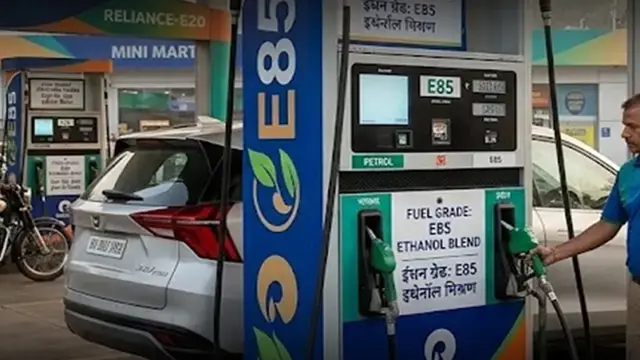
E85 fuel has been launched in India. So what is E85 fuel and which vehicles can use it and what is the cost per liter and everything else that you need to know about it, you can find here. According to Indian Oil Corporation (IOCL)’s official X handle, “Introducing E85 – a fuel that brings together sustainability, affordability, and self-reliance.” The post also says that E85 fuel is , “85% Ethanol Blended Petrol, Up to 61% lower greenhouse gas emissions, More economical than petrol, 100% Aatmanirbhar fuel, Supports higher farmer income, Designed for Flex Fuel Vehicles. IOCL further adds, “A greener drive. A stronger India.”
Government in the official press release said that, the entry of flex-fuel technology into the passenger vehicle segment is not merely a product launch, but also the beginning of a new chapter in India’s energy transition. It is to be further noted that India has nearly 37 lakh passenger vehicles representing the aspirations of middle-class India and the future of personal mobility. Large-scale adoption of flex-fuel technology in this segment can significantly multiply the impact of ethanol-based mobility.
Introduction Of Ethanol Blended Fuel
Availability, affordability and sustainability is at the base of the fuel transformation in our country. India now has the capability to produce ethanol from multiple feedstock sources such as broken grains, agricultural waste, bamboo and sea weed. Ethanol blending has increased from less than 1.5% in 2013-14 to 20% in 2025-26, achieving the target 5 yrs ahead of the schedule.
Ethanol procurement has risen from about 38 crore litres in ESY 2013-14 to more than 1,040 crore litres today, while ethanol production capacity expanded nearly five fold from 421 crore litres in 2014 to ~2000 crore litres in 2026. This shift has reduced crude oil imports, saved foreign exchange, lowered emissions, and increased farmer’s income.
Why E85 Fuel And What Is The Price Per Liter
NITI Aayog officially classifies ethanol-based Flex-Fuel Vehicles (FFVs), including vehicles running on high ethanol blends such as E85, as Zero-Emission Vehicles. E85 fuel also produces near-zero particulate matter (PM) emissions, making flex-fuel vehicles a promising solution for addressing the country’s growing air pollution challenge.
It is worth noting that another attempt is to use Sustainable Aviation Fuel (SAF).The Government of India is working closely with oil marketing companies, airlines, and global technology partners to develop and scale up SAF. Like ethanol, India will adopt a phased approach to SAF adoption. A blending mandate has already been initiated, with a target of 1% blending for international flights by 2027, increasing to 2% by 2028, and scaling further as supply stabilizes. Notably, the Indian Oil Corporation Ltd. Refinery in Panipat, is using used cooking oil to produce SAF—showcasing India’s innovative and sustainable pathway forward.
According to reports, the newly launched E85 fuel is priced at Rs. 82.12 per litre in New Delhi. However it is yet to be launched in other states and cities. The government has plans of launching it in a phased manner.
Flex Fuel Vehicles In India
Union Minister for Petroleum and Natural Gas Hardeep Singh Puri recently launched India’s first flex-fuel passenger vehicle by Maruti Suzuki in New Delhi, fuelling the vision of Aatma Nirbhar Bharat. Union Minister for Road, Transport and Highways, Nitin Gadkari was also present during the event. Flex-fuel vehicles can operate on a range of ethanol–petrol blends, from E20 up to E100.
In addition to Maruti, Hero MotoCorp has also launched E85 or Flex Fuel compatible bikes. The Company has shared the news on its official X handle and said, “India’s first Flex Fuel motorcycles are now a reality. Splendor+ and HF Deluxe – Made in India. Built for India. Powered by India. Hon’ble Union Ministers Shri Nitin Gadkari, Minister of Road Transport and Highways and Shri Hardeep Singh Puri, Minister of Petroleum & Natural Gas marked this as a defining moment for local ethanol adoption and the vision of Aatmanirbhar Bharat. Homegrown innovation. Engineered at our CIT, Jaipur, these motorcycles reflect our focus on sustainable, future- ready mobility.”
The Minister said the entry of flex-fuel technology into the passenger vehicle segment is not merely a product launch, but also the beginning of a new chapter in India’s energy transition. Puri noted that India has nearly 37 lakh passenger vehicles and the large-scale adoption of flex-fuel technology in this segment can significantly multiply the impact of ethanol-based mobility. It is worth mentioning here that E20 usage results in reduction in greenhouse gas emissions, improves air quality, enhances engine performance, and has already led to over Rs. 1.4 lakh crore in foreign exchange savings. (Source: PIB)
Introducing E85 – a fuel that brings together sustainability, affordability, and self-reliance.
✔ 85% Ethanol Blended Petrol
✔ Up to 61% lower greenhouse gas emissions*
✔ More economical than petrol
✔ 100% Aatmanirbhar fuel
✔ Supports higher farmer income
✔ Designed for… pic.twitter.com/ZMkZnDCHLq— Indian Oil Corp Ltd (@IndianOilcl) June 5, 2026