
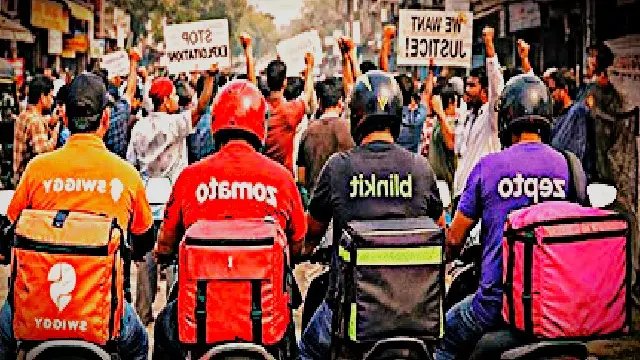
There has been a lot of talk around the end of the era of ’10 minutes delivery’ in India. An MP raised the issue in the Parliament and then the matter was taken up and discussed this led to a huge uproar on social media.
People talked about the safety and security of these workers and the payment that they are given in return. This then resulted in the Labour Ministry of India banning the ’10 minutes delivery’ by various e-commerce and quick-commerce platforms. Lets know what all unfolded before the final decision.
So how it all began
Quick commerce saw rapid growth in the Indian cities during and after the Covid pandemic. The operation is simple- the platforms use small neighbourhood godowns to supply groceries, emergency personal use items and household goods within minutes. This is what makes them popular and convenient.
With the popularity came problems, it all began with a protest by the gig workers saying that the labour laws are being flouted and that they are not being paid in accordance to the laws.
Later the protest was supported and the matter raised by an MP in the Parliament. This took the matter to the social media where it was debated, discussed and dissected.
The MP further said that said under the 10-minute delivery guarantee, a gig worker drives recklessly, becomes increasingly anxious, risks losing incentives, and faces customer abuse if the delivery is late, while not receiving any regular worker protections.
As part of improving working conditions and rights for workers, the MP had further proposed setting working hours for gig workers to end the practice of people working 14-16 hours a day for incentives.
Meanwhile the gig workers across the country prepared for a seize work on December 31 to protest against the unfair working conditions, low wages, and the lack of social security. They further warned that that delivery services will be severely disrupted during peak hours. However the companies were quick to act, they promised to raise the wages overnight leading to stoppage of the protest.
The Follow Up
A government press release titled, ‘India’s Labour Reforms: Simplification, Security, and Sustainable Growth’ it has been clearly mentioned that, “The Code extends social security to all workers- including unorganized, gig, and platform workers-covering life, health, maternity, and provident fund benefits, while introducing digital systems and facilitator-based compliance for greater efficiency.”
Post passing and elaboration of the above paragraph, the Labour Ministry decided to scrap the system of ’10 minutes delivery’ in India.
The MP then took to his X handle and wrote, “I am deeply grateful to the Central Government for its timely, decisive and compassionate intervention in enforcing the removal of the “10-minute delivery” branding from quick-commerce platforms. This is a much needed step because when “10 minutes” is printed on a rider’s tshirt/ jacket/ bag and a timer runs on the customer’s screen, the pressure is real, constant, and dangerous.
He further explained, “This step will help ensure safety of the delivery riders, and everyone who shares our roads. Over the past months, I have spoken to hundreds of delivery partners. Many are overworked, underpaid and risking their life to fulfil an unrealistic promise. I thank every citizen who stood with us – you stood firmly on the side of human life, safety & dignity. And to every gig worker – you’re not alone, we’re all with you.”
Following this, the Founder of Zomato, Blinkit, District, etc took to his LinkedIn handle and wrote, “Our 10 minute delivery promise is enabled by the density of stores around your homes. It’s not enabled by asking delivery partners to drive fast. Delivery partners don’t even have a timer on their app to indicate what was the original time promised to the customer.”
He further calculated and explained, “After you place your order on Blinkit, it is picked and packed within 2.5 minutes. And then the rider drives an average of under 2kms in about 8 minutes. That’s an average of 15kmph. I understand why everybody thinks why 10 minutes must be risking lives, because it is indeed hard to imagine the sheer complexity of the system design which enables quick deliveries.”
He added, “Also, if you’ve ever wanted to know why millions of Indians voluntarily take up platform work and sometimes even prefer it to regular jobs, JUST ASK any rider partner when you get your next food or grocery order. You will be humbled by how rational and honest they will be with you.”
He accepted that, “Having said that, no system is perfect, and we are all for making it better than today. However, it is far from what it is being portrayed on social media by people who don’t understand how our system works and why. If I were outside the system, I would also believe that gig workers are being exploited, but that’s not true.”
Here is the video shared by the MP and his experience as a gig worker at a popular e-commerce platform:
I lived a day as a delivery partner and saw firsthand the pressure, risks and challenges created by the “10-minute delivery” promise.
The reality behind the promise..
RELEASING SOON.. pic.twitter.com/ulhkLWWmIE
— Raghav Chadha (@raghav_chadha) January 14, 2026